

Summary
- FDA has finalized its guidance on validating IVDs for emerging pathogens during a section 564 declared emergency, the playbook for pre-EUA and EUA requests [1].
- The core analytical package is now five study areas: limit of detection, inclusivity, specimen stability, safety/software/EMC, and usability [1].
- Clinical evidence can scale with the outbreak stage, from contrived samples early on to prospective natural specimens later [1].
- Point-of-care and home tests get concrete, user-focused study recommendations [1].
- A pre-EUA can be filed before any emergency is declared, so preparation can start now [1].
- An EUA is temporary; plan your route to a 510(k) or De Novo from day one [5].
If you develop molecular or antigen tests for infectious disease, the next outbreak is not the time to learn what FDA expects. During COVID-19, many diagnostics teams built EUA packages under intense time pressure, with requirements that shifted as the emergency evolved. FDA has now put its emerging pathogen IVD validation expectations in writing. In November 2026, the agency finalized Validation of Certain In Vitro Diagnostic Devices for Emerging Pathogens During a Section 564 Declared Emergency, along with a general EUA and pre-EUA template [1][2].
The draft, released in January 2025, was a response to two independent reviews of FDA's COVID-19 response that recommended a validation framework and EUA templates for future emergencies [3]. The final version is leaner. Coverage of the guidance reports that the list of expected analytical tests was cut from 15 to five, and that the draft's fixed minimum of 30 positive and 30 negative clinical specimens was relaxed for most tests [2].
Here is what the final guidance means for your EUA readiness, and how to act on it before you need it.
1. Confirm Your Test Is in Scope
The guidance covers diagnostic tests that detect a pathogen to help diagnose a serious or life-threatening disease covered by an applicable section 564 declaration. Screening tests are included as a subset of diagnostic tests. Serology and other antibody tests are excluded [1]. It applies to data submitted in a pre-EUA, an EUA request, or for a test offered under an applicable enforcement discretion policy, and it includes some recommendations for home specimen collection kits and related software [1].
Whether FDA issues an enforcement discretion policy in a future emergency is a separate decision. FDA explained the factors it will weigh in a September 2025 final guidance [4].
How to approach it: Write a one-page scope memo for each infectious disease platform you own: the analyte type, specimen types, intended setting (lab, point of care, home) and whether the test would fall inside this guidance. If you work on antibody tests, do not assume this framework applies.
2. Build Your Analytical Package Around Five Core Studies
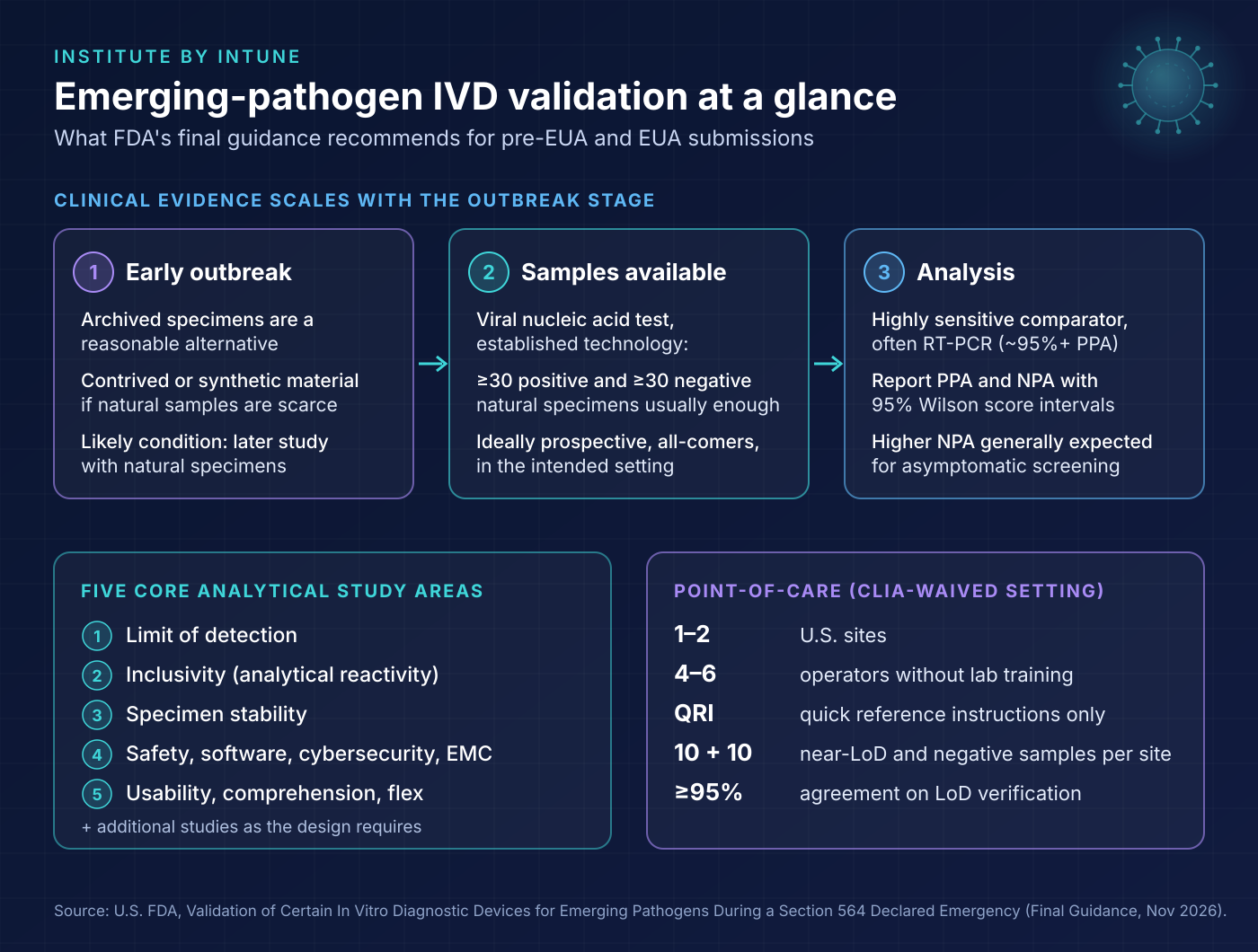
The final guidance recommends five core areas of analytical evaluation [1]:
- Limit of detection (analytical sensitivity)
- Inclusivity (analytical reactivity)
- Specimen stability
- Basic safety, software validation, cybersecurity and electromagnetic compatibility testing
- Usability, user comprehension and flex studies
It also lists potential additional testing that may apply depending on the design, such as cross-reactivity, microbial interference, endogenous and exogenous interference, carry-over, high-dose hook effect for antigen tests, fresh versus frozen comparability and analytical equivalency [1]. A shorter core list does not mean less thinking. You still need to decide, and justify, which additional studies your design calls for.
How to approach it: Map every analytical study you would run for a traditional 510(k) against these five areas. Pre-write protocols for the core studies, and keep a short rationale for each additional study you plan to include or leave out. Where CLSI-based designs already exist in your quality system, reuse them.
3. Match Your Clinical Evaluation to the Outbreak Stage
This is the biggest practical shift for EUA clinical study design. FDA states that validation for an EUA requires a lower level of evidence than the effectiveness standard used for full marketing authorization, and that recommendations should be adjusted to the outbreak stage and the availability of materials [1].
In practice, the guidance describes a progression [1]:
- Early outbreak: archived specimens are a reasonable alternative; contrived samples may be used if natural specimens are not available, and synthetic material may be acceptable when pathogen stocks are not. Such authorizations would likely carry a condition requiring a later clinical evaluation with natural specimens.
- When samples and comparators are available: for a viral nucleic acid test using established technology, at least 30 positive and 30 negative specimens are typically adequate, ideally from a prospective, all-comers study in the intended population and setting.
- Comparator and analysis: use a highly sensitive comparator, often RT-PCR, that itself shows about 95% or higher positive agreement on natural specimens, and report positive and negative percent agreement with 95% Wilson score confidence intervals.
How to approach it: Draft two or three versions of your clinical protocol now, one for each outbreak stage. Line up specimen sources, biobank partners and a comparator method in advance. If you plan to enrich an asymptomatic population, the guidance says to discuss that with FDA first [1].
4. Design Point-of-Care and Home Tests for the Real User
For tests intended for CLIA-waived settings, the guidance recommends a clinical evaluation at one or two U.S. sites with four to six operators who have no laboratory training and who rely only on the quick reference instructions. It also recommends a near-LoD verification at each site, with 10 samples at or below three times the LoD and 10 negatives, and an agreement of at least 95% [1].
For home collection and home use, the guidance asks for validation of the full workflow, from kit distribution through collection, storage and shipping, and for quick reference instructions of one to two pages written at no higher than a 7th-grade reading level, with pictures [1].
How to approach it: Treat usability as a study, not a labeling task. Recruit realistic operators, test your instructions early, and select POC sites that can actually provide untrained operators and the right patient flow. Site choice drives how quickly these studies finish.
5. Use the Pre-EUA Before There Is an Emergency
A pre-EUA lets you start a conversation with FDA early, and it can be submitted before or during a declaration. It can become an EUA request only while an applicable declaration is in effect [1]. FDA notes that following the guidance early may make a future EUA request more complete [1].
Human subject protections still apply. Studies must meet IRB and informed consent requirements, a December 2023 rule allows IRBs to waive or alter consent for certain minimal-risk studies, and IDE rules may apply to some studies [1].
How to approach it: If your platform could plausibly respond to a future outbreak, consider a pre-EUA package built on the FDA template. Pair it with an IRB strategy and an IDE determination for each planned study so that ethics review does not become your bottleneck.
6. Plan for Life After the EUA
EUAs are temporary. When the COVID-19 declarations ended, FDA issued transition guidances that gave manufacturers a 180-day transition period and encouraged them to prepare marketing submissions and use pre-submissions where needed [5]. The new guidance also describes conditions of authorization that may require post-authorization clinical data with natural specimens, and it invites manufacturers to propose a change protocol for future modifications, with planned changes, validation steps and acceptance criteria [1].
How to approach it: Design your EUA studies so the data can carry forward into a 510(k) or De Novo. Choose a comparator, specimen strategy and statistical plan that will hold up under the full effectiveness standard, and draft a change protocol early. That way an EUA is a bridge, not a dead end.
Final Thought
The final emerging-pathogen guidance gives diagnostics developers something they did not have in 2020: a clear, scalable validation framework before the emergency begins. The teams that benefit most will be the ones who turn it into protocols, specimen plans, site lists and a pre-EUA package now, while there is time to do it well.
At Intune Bio Services, we help diagnostics companies, including non-US manufacturers entering the US market, with EUA and pre-EUA strategy, Q-Submissions, 510(k) and De Novo pathways, CLSI-based analytical study design and the management of clinical, point-of-care and CLIA waiver studies.
Want to be EUA-ready before the next outbreak? Get in touch and let's build your validation plan together.
Sources:
[1] U.S. FDA. Validation of Certain In Vitro Diagnostic Devices for Emerging Pathogens During a Section 564 Declared Emergency, Final Guidance, November 2026. Docket FDA-2024-D-2707. fda.gov
[2] RAPS. "FDA slashes number of analytical tests for IVDs used in public health emergencies," Regulatory Focus, November 9, 2026. raps.org
[3] Federal Register. Validation of Certain In Vitro Diagnostic Devices for Emerging Pathogens During a Section 564 Declared Emergency; Draft Guidance; Availability, January 7, 2025 (90 FR 1168). govinfo.gov
[4] U.S. FDA. Consideration of Enforcement Policies for In Vitro Diagnostic Tests During a Section 564 Declared Emergency, Final Guidance, September 2025. fda.gov
[5] U.S. FDA. "FDA Issues Final Guidances to Assist with Transition Plans for COVID-19-Related Medical Devices," March 24, 2023. fda.gov