
Summary
If you are planning a clinical study for a new diagnostic, one of the first questions on the table is deceptively simple: does this IVD clinical study need an IDE?
Get the answer wrong in one direction and you spend months preparing an Investigational Device Exemption application you never needed. Get it wrong in the other and you may run a study that does not meet FDA requirements, which can put the data behind your 510(k), De Novo or CLIA waiver submission at risk.
The question is especially timely. On October 27, 2026, FDA published draft guidance describing an electronic submission template for IDE applications to CDRH and CBER, with comments due December 28, 2026 [1]. If your program may need an IDE, now is a good time to understand where your study sits. Here is a practical way to work through it.
1. Start With the Four IDE Exemption Tests for Diagnostics
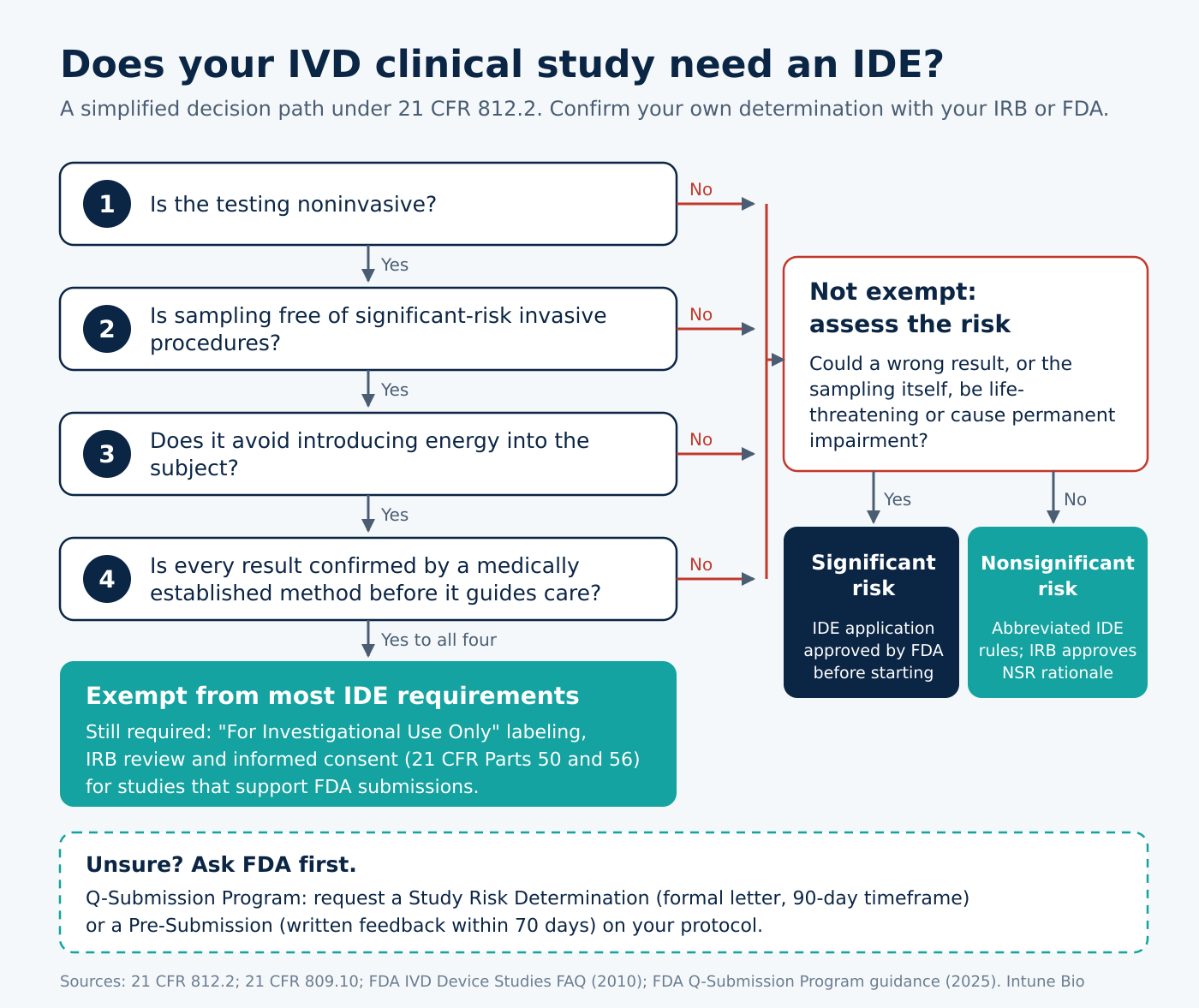
Under 21 CFR 812.2(c)(3), a diagnostic device study is exempt from most of Part 812 when the sponsor complies with the IVD labeling rule in 21 CFR 809.10(c) and the testing [2]:
All four must be true. Many specimen-based studies, such as testing leftover samples or comparing a new assay against a reference method, can meet them. But "most IVD studies are exempt" is not the same as "my study is exempt."
How to approach it: Write the four criteria into your study plan and answer each one in a sentence, with a reference to the protocol section that supports it. If any answer needs a "but," treat the study as possibly non-exempt until you resolve it.
2. Watch the "Confirmation" Criterion Most Closely
FDA's IVD study FAQ guidance explains that in an exempt study, investigational results "should not influence patient treatment or clinical management decisions" before the diagnosis is established by a medically established method [3]. Investigators must rely on established means of diagnosis for treatment decisions for every subject [3].
This gets tricky in a few common situations:
How to approach it: Spell out in the protocol who sees investigational results, when, and what they may and may not do with them. Blinding investigational results from treating clinicians, or requiring confirmation before any action, keeps the design clean.
3. Remember That Exempt Does Not Mean Unregulated
An exemption from Part 812 removes the need for an IDE. It does not remove other obligations.
How to approach it: Build a short compliance checklist for every site: labeled product, IRB approval or a documented IRB determination, a consent approach, and a specimen chain-of-custody plan. Check it during site initiation, not at close-out.
4. If the Study Is Not Exempt, Assess Significant vs. Nonsignificant Risk
A study that fails any exemption test is not automatically a full IDE. The next question is risk.
FDA's guidance describes misdiagnosis as significant risk when the resulting harm could be life-threatening or cause permanent impairment, and it walks through harms from both false positives (such as unnecessary invasive treatment) and false negatives (such as delayed treatment) [3]. It also treats certain sampling procedures as significant risk, including major organ biopsy, general anesthesia, or arterial or large-vein access [3].
How to approach it: Write a short risk rationale that walks through both false-positive and false-negative scenarios for your intended use population. IRBs and FDA reviewers both respond better to a reasoned argument than to a one-line conclusion.
5. Plan Specimen Sourcing and Consent Early
For diagnostics, the specimens are often the study. Where they come from shapes the consent question.
FDA's IVD guidance describes limited circumstances in which it intends to use enforcement discretion on informed consent for leftover specimens that are not individually identifiable [3]. If a participant's original consent covered future use of excess specimens and the new study fits those terms, further consent may not be needed; sponsors should work with the IRB, which also considers state and local rules [3].
Separately, FDA's final rule adding 21 CFR 50.22, effective January 22, 2024, allows an IRB to waive or alter informed consent for certain minimal-risk clinical investigations when it finds and documents specific criteria. These include that the research could not practicably be carried out without the waiver and that the waiver will not adversely affect subjects' rights and welfare [6].
How to approach it: Decide your specimen strategy (prospective collection, leftover clinical samples, banked or purchased specimens) before you finalize the protocol, and bring the consent plan to your IRB early. For banked or purchased specimens, confirm what the original consent and documentation actually allow.
6. Ask FDA Before You Start, Not After
When the answer is not clear, you do not have to guess. FDA's Q-Submission guidance lists a Study Risk Determination request, where FDA determines whether a planned study is SR, NSR or exempt, and it notes that "FDA is the final arbiter as to whether a device study is SR or NSR" [5]. FDA provides that determination as a formal letter, with a 90-day timeframe listed in the guidance [5].
A Pre-Submission is often the better tool when you also want feedback on study design, comparator choice or statistical plans. Written feedback is due within 70 calendar days of the review clock starting [5]. FDA's IVD guidance has long encouraged early feedback on protocols, especially for novel devices [3].
And if an IDE is needed, keep an eye on FDA's draft electronic IDE template guidance. It describes resources intended to act as guided submission preparation tools, and says the final version will set further electronic-format standards and a timetable [1].
How to approach it: Build the Q-Sub timeline into your study plan from day one. Running a Pre-Sub on your clinical protocol while sites are being qualified keeps the regulatory answer off the critical path.
Final Thought
The IDE question is not paperwork; it is a study design decision. How you handle confirmation, risk, labeling and specimens determines whether your data will hold up when it reaches FDA. Teams that answer it early, in writing, and with FDA's input when needed tend to avoid the costliest surprise in diagnostics development: a completed study that cannot support the submission it was designed for.
At Intune Bio Services, we help diagnostics companies, including non-US manufacturers entering the US market, design and manage analytical, clinical and CLIA waiver studies, from IDE and study-risk strategy and Q-Submissions to protocol design, site selection and CRO oversight.
Planning an IVD clinical study? Get in touch and let's map out the right regulatory path before your first specimen is collected.
Sources:
[1] U.S. FDA. Electronic Submission Template for Investigational Device Exemption (IDE) Applications (Draft Guidance), October 2026. Docket FDA-2026-D-11188. fda.gov
[2] 21 CFR 812.2, Applicability (Investigational Device Exemptions). law.cornell.edu
[3] U.S. FDA. In Vitro Diagnostic (IVD) Device Studies – Frequently Asked Questions, Guidance for Industry and FDA Staff, June 2010. fda.gov
[4] 21 CFR 809.10, Labeling for in vitro diagnostic products. law.cornell.edu
[5] U.S. FDA. Requests for Feedback and Meetings for Medical Device Submissions: The Q-Submission Program, Final Guidance, May 2025. hhs.gov
[6] U.S. FDA. Final Rule: Institutional Review Board Waiver or Alteration of Informed Consent for Minimal Risk Clinical Investigations. Federal Register, December 21, 2023 (effective January 22, 2024). govinfo.gov