

Summary
- FDA is moving oncology companion diagnostics (CDx) out of class III, one technology at a time, so new tests can reach market through a 510(k) instead of a PMA [1][2][3].
- In situ hybridization (ISH) CDx tests are already class II under a final order that took effect in September 2026 [2].
- On November 12, 2026, FDA proposed the same move for immunohistochemistry (IHC) CDx tests, covering 12 product codes [1].
- Nucleic acid-based oncology CDx tests were proposed for class II in November 2025 [3].
- Class II still means special controls: cut-off validation, reader precision, clinical performance data and labeling that matches the drug label [1][2].
- Existing PMA-approved tests can stay on the market, but future significant changes would go through a 510(k) [1][2].
If you develop oncology tests that are paired with a cancer therapy, the regulatory ground under you is shifting. For more than two decades, a companion diagnostic has meant a premarket approval (PMA) application: the most demanding pathway FDA has. Now the agency is working through a companion diagnostic reclassification program that moves several oncology CDx test types into class II, where a CDx 510(k) with special controls replaces the PMA.
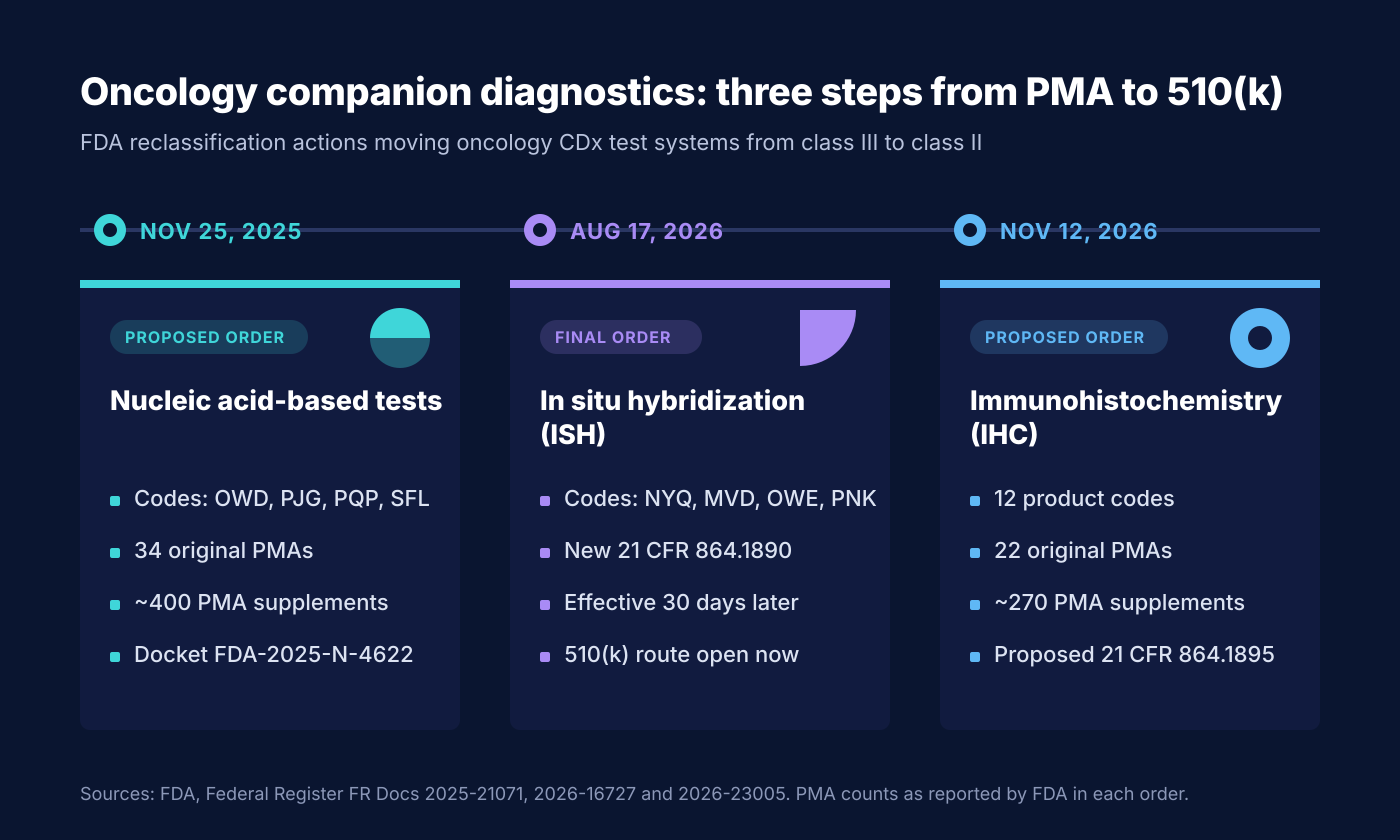
The newest step landed on November 12, 2026, when FDA published a proposed order to reclassify IHC test systems used with an approved oncology therapy [1]. It follows a final order for ISH tests in August [2] and a proposed order for nucleic acid-based tests in November 2025 [3]. FDA says plainly why this matters: a 510(k) "typically results in a shorter premarket review timeline compared to a PMA" [2].
Shorter does not mean lighter on evidence, though. Here is how to read the three actions and turn them into a regulatory plan.
1. Know Where Each Companion Diagnostic Reclassification Stands
The three actions are at different stages, and that difference drives what you can do today.
- ISH (final). FDA finalized the order on August 17, 2026, creating 21 CFR 864.1890 for ISH test systems used with a corresponding approved oncology therapy. It covers product codes NYQ, MVD, OWE and PNK and became effective 30 days after publication [2].
- IHC (proposed). The November 12 proposal would create 21 CFR 864.1895 and cover 12 product codes. FDA notes it has approved 22 original PMAs for these tests since the first in 1998, plus about 270 PMA supplements [1]. Comments are open for 60 days, under docket FDA-2026-N-12508 [1].
- Nucleic acid-based (proposed). Proposed on November 25, 2025, this order covers product codes OWD, PJG, PQP and SFL, a group with 34 original PMAs and roughly 400 supplements behind it [3].
How to approach it: Treat ISH as open for 510(k) submissions now. For IHC and nucleic acid-based tests, keep planning for a PMA but build your evidence so it also satisfies the proposed special controls, and track both dockets for final orders.
2. Map Your Assay to the Right Regulation and Product Code
Each order is written around a specific technology and a specific link to a drug. The IHC proposal, for example, covers tests that detect protein expression in human specimens and are indicated for use with a corresponding approved oncology therapeutic [1]. It describes two groups: tests that are essential for safe and effective use of the drug, and tests that give information about the drug's known benefits or risks without being essential [1].
FDA also flagged that several IHC product codes are mislinked to another regulation in its databases and called this "an administrative error" it will correct [1]. Small details like this matter when you search for predicates and classification history.
How to approach it: Confirm your technology, product code and intended use against the exact regulation text before you design studies. If your test does not fit cleanly, settle it early in a Q-Submission rather than in a 510(k) review.
3. Build the CDx 510(k) Around the Special Controls
Class II comes with special controls, and for these tests they are detailed. For ISH tests, the final order calls for validation of cut-offs using borderline samples, precision and reproducibility data, analytical sensitivity and specificity, robustness, specimen stability and clinical data from specimens representative of the intended use population [2]. The proposed IHC controls follow the same pattern and add antibody specificity work and inter- and intra-reader precision, with multi-site reproducibility for tests used at more than one site [1].
FDA did make two practical changes in the ISH final order after public comment. It allowed surrogate samples to supplement clinical specimens in precision studies, and it dropped a separate reagent stability requirement [2]. It also said it will not issue a separate guidance on the special controls [2], so the regulation text is your checklist.
How to approach it: Turn each special control into a line in your design verification and validation plan. Use CLSI-based protocols for precision and specimen stability, and plan clinical specimens near the clinical cut-off early, because they are the hardest to source.
4. Keep Labeling Locked to the Drug Label
A companion diagnostic only makes sense next to its therapy. Under the ISH final order, test labeling must be consistent with the labeling of the corresponding approved oncology drug [2]. The IHC proposal carries the same requirement, plus a limiting statement that results be read by a qualified reader alongside other clinical information [1].
How to approach it: Coordinate with your pharma partner on indication language before you file. When the drug label changes, assess whether your test labeling and performance claims need to change with it.
5. Plan Lifecycle Changes for PMA-Approved Tests
If you already hold a PMA, you are not forced to resubmit. Both orders say tests with prior PMA approval may continue to be marketed under that approval [1][2]. The change comes later: for significant modifications, FDA expects a 510(k) for the modified device [2].
How to approach it: Review your planned changes, such as new specimen types, new cut-offs or new indications, and decide which would trigger a 510(k) under the new framework. A predetermined change control plan may also be worth discussing with FDA [1].
6. Comment on the IHC Proposal While You Can
The IHC order is still a proposal. Its special controls, product-code scope and labeling language can change based on what FDA hears during the 60-day comment period [1]. The ISH final order shows that comments do shape the result, from surrogate samples to reagent stability [2].
How to approach it: If you develop or plan IHC companion diagnostics, review the proposed special controls against your current data packages and file specific, evidence-based comments on docket FDA-2026-N-12508 before the deadline.
Final Thought
The companion diagnostic reclassification program does not lower the evidence bar so much as change the vehicle. Teams that map their assays to the right regulation, build studies around the special controls and keep labeling tied to the drug will be the first to benefit from faster 510(k) reviews.
At Intune Bio, our regulatory affairs team helps diagnostics companies, including non-US manufacturers entering the US market, with pathway and product-code strategy, Q-Submissions, 510(k) and De Novo submissions, and CLSI-based analytical study design. Our clinical services team manages the analytical, reproducibility and clinical performance studies that special controls require.
Planning a companion diagnostic under the new class II rules? Get in touch and let's map your pathway together.
Sources:
[1] U.S. FDA. Hematology and Pathology Devices; Reclassification of Immunohistochemistry Test Systems for Use With a Corresponding Approved Oncology Therapeutic Product, Proposed Order, Federal Register, November 12, 2026. FR Doc. 2026-23005, Docket FDA-2026-N-12508. federalregister.gov
[2] U.S. FDA. Hematology and Pathology Devices; Reclassification of In Situ Hybridization Test Systems for Use With a Corresponding Approved Oncology Therapeutic Product, Final Order, Federal Register, August 17, 2026. FR Doc. 2026-16727, Docket FDA-2025-N-1243. federalregister.gov
[3] U.S. FDA. Immunology and Microbiology Devices; Reclassification of Nucleic Acid-Based Test Systems for Use With a Corresponding Approved Oncology Therapeutic Product, Proposed Order, Federal Register, November 25, 2025. FR Doc. 2025-21071, Docket FDA-2025-N-4622. federalregister.gov