

Summary
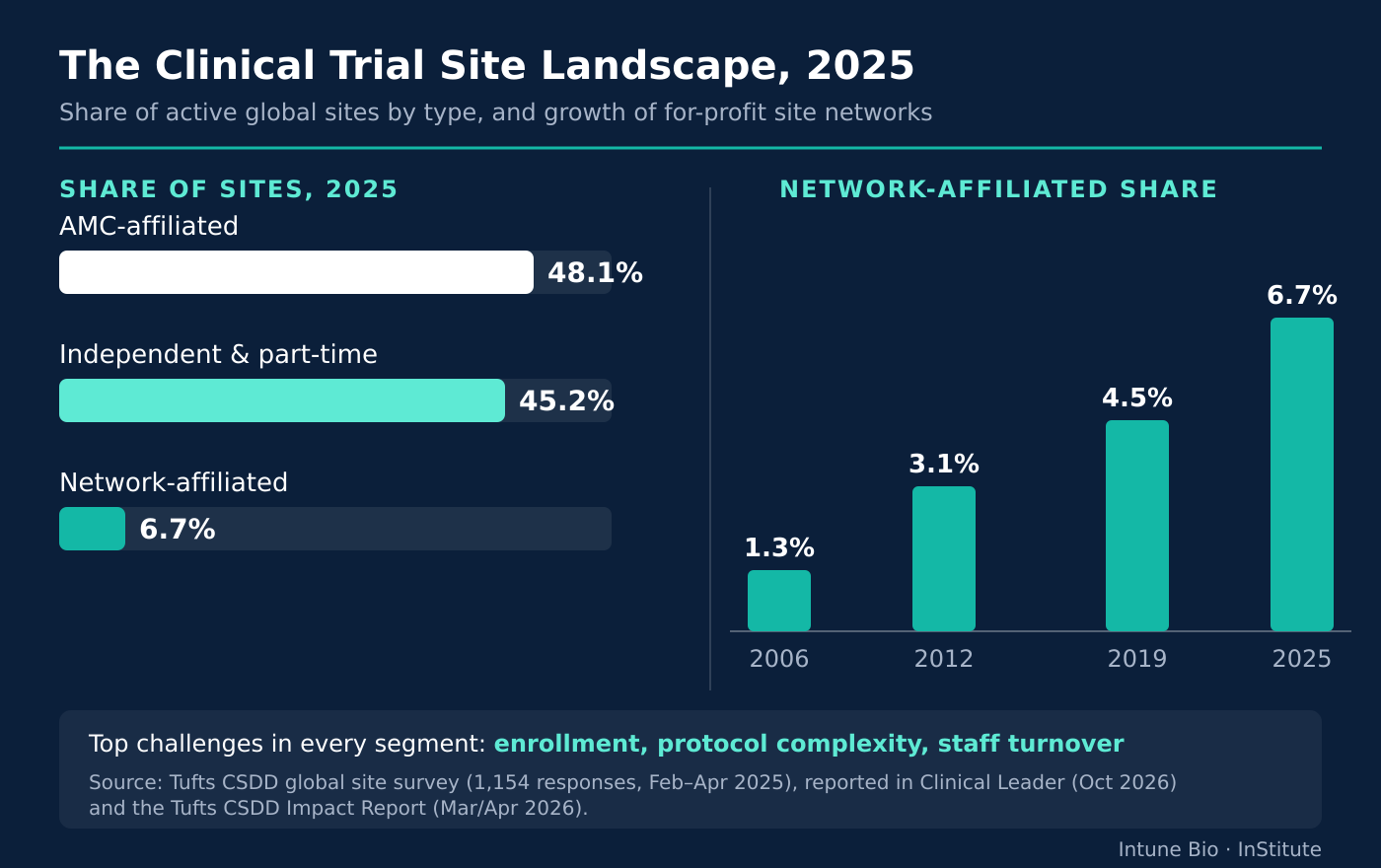
- The clinical trial site landscape is shifting. Academic medical centers (AMCs) held 48.1% of active global sites in 2025, and for-profit site networks grew to 6.7%, up from 1.3% in 2006.
- Each site type brings different strengths in patient access, capacity and how sites run their research business.
- The same three problems top every segment's list: enrollment, protocol complexity and staff turnover.
- Network sites report more commercial pressure and more friction working with CROs than other segments.
- Comparative performance data is still thin, so treat site type as a starting hypothesis, not a verdict.
- ICH E6(R3) puts the burden on sponsors to pick investigators who can show real resources and recruitment potential.
- The fix: build a deliberate site mix and verify each site's track record, whatever its type.
Most clinical operations teams pick sites one at a time: a trusted PI here, a CRO recommendation there, a few names from a feasibility survey. The result is a site list, but rarely a site mix designed on purpose.
That matters more now. New research from the Tufts Center for the Study of Drug Development (Tufts CSDD) shows that the balance between AMC, independent and network-affiliated sites is changing, and that each type operates differently [1][2]. If you are planning a study for 2027, the question is no longer just "which sites?" but "what kind of clinical trial site types, in what proportions, and why?"
Here is how to read the new data and turn it into a practical selection plan.
1. Know How the Clinical Trial Site Landscape Has Shifted
Tufts CSDD worked with a group of sponsors and CROs and surveyed sites registered on ClinicalTrials.gov between late February and early April 2025, collecting 1,154 responses [1][2]. They grouped sites into three segments: AMC-affiliated, independent and part-time, and for-profit site networks.
Three shifts stand out [1][2]:
- AMCs are regaining share. AMC-affiliated sites made up 48.1% of active global sites in 2025, reversing a long decline.
- Networks are growing fast from a small base. Network-affiliated sites reached 6.7% of the landscape, up from 1.3% in 2006.
- Independent sites are shrinking. They fell from 52.8% of sites in 2019 to 45.2% in 2025 [1].
How to approach it: Look at your last three site lists and tag each site by type. If one segment dominates without a clear reason, your selection habits, not your protocol, may be shaping your site mix.
2. Match Site Type to Your Patient Population
Site type is a rough proxy for who can get to the site and how. Tufts CSDD found that AMC sites had the highest share of patients traveling more than 100 miles on average [1], which fits their role as referral centers for complex and rare conditions.
Community-based sites tell a different story. Network-affiliated sites in the survey were far more likely than AMCs to offer mobile research units (19.9% vs. 2.2%), and independent sites were also well ahead of AMCs at 11.5% [2]. For studies that depend on reaching people close to home, that kind of flexibility can matter as much as PI reputation.
How to approach it: Start from the patient journey, not the site list. Write down where your eligible patients are diagnosed and treated today, how far they will travel and how often they must visit. Then choose the site types that sit closest to that journey.
3. Expect the Same Pain Points Everywhere
It is tempting to assume one site type has fewer problems. The data does not support that. Across all three segments, sites most often ranked participant enrollment, protocol complexity and staff turnover among their top challenges [1][2].
Some differences do show up. Network sites were the most likely to cite pressure to make a profit (22.1%) and communication and collaboration with CROs (19.5%) among their top challenges [1][2]. Independent sites also flagged CRO communication at 17.2% [1][2].
How to approach it: Before you sign, ask each site directly how it handles turnover, who covers the study if the coordinator leaves, and how it prefers to communicate with your CRO. Build those answers into your oversight plan instead of discovering them at the first missed milestone.
4. Treat Site-Type Performance Data With Care
The Tufts CSDD team also looked at sponsor-reported enrollment data and suggested that network-affiliated sites may offer enrollment advantages [1]. But the authors are candid: the main limitation is the small sample of sponsor-reported performance data [1].
That is an important caution. A site's type tells you something about its structure. It does not tell you whether a particular site will enroll your particular protocol. Every segment includes strong performers and sites that struggle.
How to approach it: Use segment-level findings to shape your hypothesis, then test it at the site level. Ask for verified enrollment, screen failure and retention data from comparable studies, not just a feasibility questionnaire. This is the gap the Intune InSite Score™ is built to fill: it scores sites on independently verified past performance rather than self-reported estimates.
5. Build Your Site Mix to Meet ICH E6(R3) Expectations
Site selection is not only a business decision; it is a GCP responsibility. FDA issued ICH E6(R3) as final guidance in September 2025 [3]. Under E6(R3), the sponsor is responsible for selecting investigators and institutions, each of which should be qualified and able to show adequate resources and facilities for the trial [4].
The guideline also expects investigators to show "a potential for recruiting the proposed number of eligible participants" within the agreed recruitment period [4], and asks sponsors to make sure all aspects of the trial are operationally feasible [4]. In other words, "we usually enroll well" is not enough. You need evidence.
How to approach it: Document why each site was chosen: its type, its patient access, its verified track record and its staffing plan. A short, written selection rationale supports your quality-by-design approach and makes later decisions, such as adding rescue sites, faster and easier to defend.
Final Thought
The site landscape is not static. AMCs are back, networks are growing and independent sites are under pressure, yet every segment is wrestling with the same core challenges of enrollment, complexity and staffing. The sponsors who do best will not be the ones who pick the "right" site type. They will be the ones who design a deliberate site mix around their patients and then verify each site's real-world performance before the first contract goes out.
Planning site selection for an upcoming study? Intune Bio helps sponsors and CROs build site lists from verified performance data, flag risk early and support activation across a global network. Get in touch to see how the Intune InSite Score™ can sharpen your next site mix.
Sources:
- Dirks A, Chambers J, Getz K. "The Site Landscape Is Evolving, But How?" Clinical Leader, October 20, 2026. https://www.clinicalleader.com/doc/the-site-landscape-is-evolving-but-how-tufts-csdd-shares-new-findings-0001
- Tufts Center for the Study of Drug Development. Impact Report, Vol. 28, No. 2, March/April 2026 (site landscape). PDF
- U.S. Food and Drug Administration. E6(R3) Good Clinical Practice (GCP), final guidance, September 2025. https://www.fda.gov/regulatory-information/search-fda-guidance-documents/e6r3-good-clinical-practice-gcp
- International Council for Harmonisation. ICH E6(R3) Guideline for Good Clinical Practice, final consolidated guideline. https://database.ich.org/sites/default/files/ICH%20E6%28R3%29_Step4_FinalConsolidatedGuideline_2026_0616_.pdf