
Summary
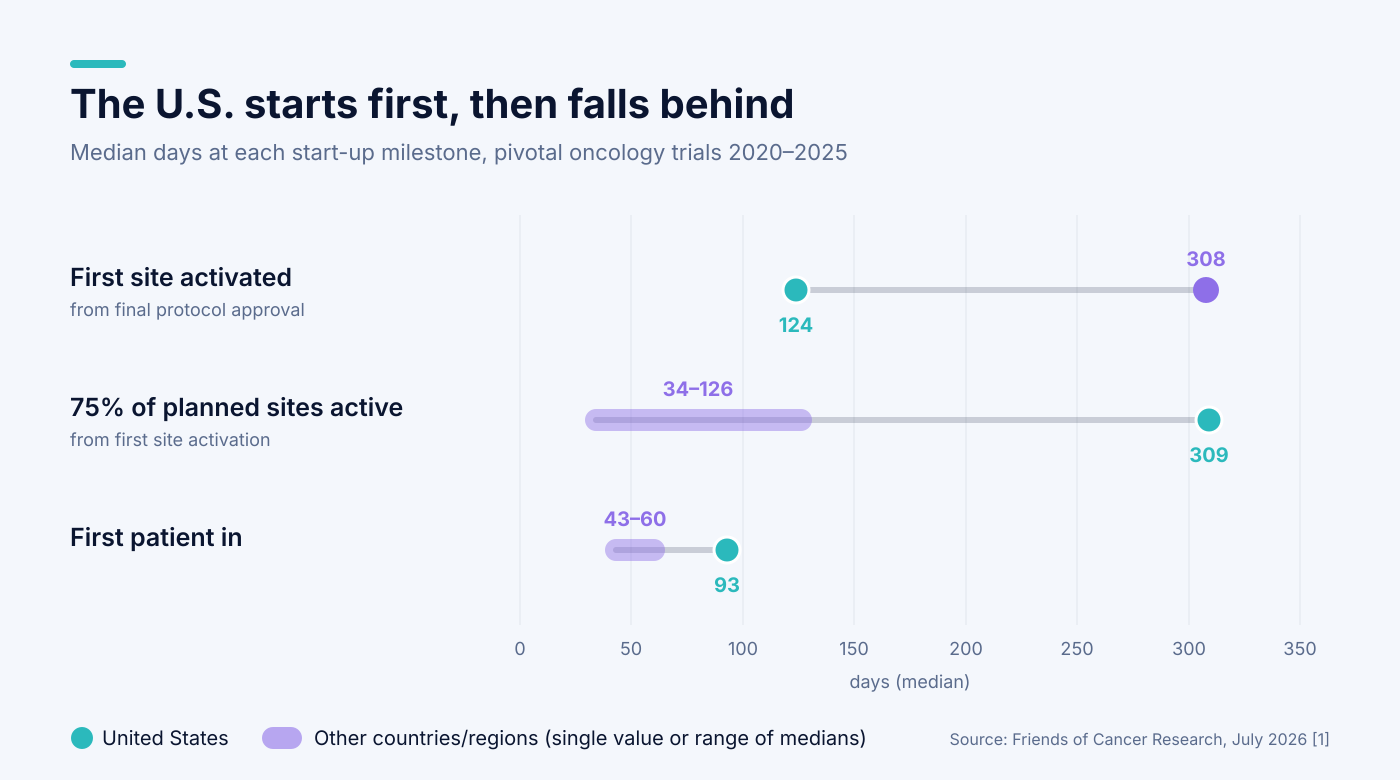
- New sponsor data shows U.S. pivotal oncology trials open their first site faster than anywhere else, with a median of 124 days after final protocol approval versus 308 days outside the U.S. [1].
- The problem is scale: U.S. trials needed a median of 309 days after that first site to activate 75% of planned sites, compared with 34–126 days in other regions [1].
- Sponsors name budget negotiations, repeated local reviews and limited site resources as the main U.S. bottlenecks [1].
- HHS's Operation TrialBlazer roadmap names the same barriers and notes that some activation times well exceed 160 days, against a 90-day benchmark [2].
- Central IRB review has been linked to much shorter start-up than local review, and FDA is considering a single-IRB rule for multi-site studies [2][3].
- Federal programs are now funding AI tools to speed site activation [4], but sponsors can act today.
- The fix: measure activation at network level, pick sites for start-up speed, and run start-up as a managed project.
Most clinical operations teams celebrate the day the first site opens. But a single open site does not enroll a pivotal trial. What matters is how fast you get from one active site to a working network, and that is where clinical trial site activation in the U.S. is falling behind.
In July 2026, Friends of Cancer Research published data from eight pharmaceutical companies on start-up timelines for global pivotal oncology trials run from 2020 to 2025 [1]. Its headline finding fits in four words: fast to start, slow to scale. With HHS now pushing to keep clinical research in the U.S. [2] and federal agencies funding new tools for faster activation [4], study start-up timelines have become a strategic issue, not just an operational one. Here is what the data says and how to respond.
1. Measure Site Activation at the Network Level, Not the First Site
The U.S. opened its first trial sites a median of 124 days after final protocol approval, compared with 308 days across all ex-U.S. sites [1]. That is a real strength. But after that first site, U.S. trials took a median of 309 days to activate 75% of planned sites, against 34 to 126 days in other regions, and needed a median of 93 days to reach first patient in, compared with 43 to 60 days elsewhere [1].
The authors conclude that the main U.S. challenge is activating a broad network of sites efficiently [1]. Context matters too: in 2025, 80% of patients in pivotal trials supporting novel FDA cancer drug approvals were enrolled outside the U.S. [1].
How to approach it: Add "time to 75% of planned sites active" to your start-up dashboard next to first-site activation. Forecast it per country at the planning stage, and treat a long tail of late sites as a risk to enrollment, not a detail.
2. Treat Budgets and Contracts as the Critical Path
Sponsors in the survey named prolonged budget negotiations as a primary U.S. bottleneck, alongside repeated local reviews and limited site resources [1]. The HHS roadmap agrees. It lists budget and contract negotiation, frequent protocol amendments during agreement talks, misaligned priorities, poor communication and the lack of a start-up roadmap as key barriers, and notes that agreeing a budget can take anywhere from a couple of weeks to several months [2]. It also points to master trial agreements and better communication as ways to shorten negotiation [2].
How to approach it: Start budget and contract work in parallel with ethics submissions, not after them [3]. Use pre-approved templates and master agreements where you can, publish a clear payment schedule up front, and lock the protocol before contracting begins. HHS cites a study finding that 45% of protocol amendments were somewhat or completely avoidable [2].
3. Cut Duplicate Ethics Reviews
Repeated, sequential local IRB and committee reviews are a major source of U.S. delay, according to the survey [1]. HHS describes the same problem: in multi-site trials without federal funding, each site may review an identical protocol on its own timeline. FDA is considering rulemaking to require a single IRB of record for multi-site cooperative studies [2].
The data supports the change. A 2021 study of large cardiovascular trials, summarized in a 2026 peer-reviewed Clinical Researcher article, found that sites using a central IRB reached regulatory approval in a median of 78 days versus 165 days with a local IRB, and completed start-up in 199 days versus 287 days [3].
How to approach it: Make central IRB reliance a selection criterion, not a nice-to-have. Ask each candidate site whether it will cede review, how its institution handles amendments, and how long its last three approvals took.
4. Select Sites for Start-Up Speed, Not Just Enrollment Promises
Site resource limits are the third bottleneck sponsors named [1]. Overstretched staff and limited availability of study leads can add weeks or months to initiation [3]. A site with the right patients but no coordinator capacity will open late, however good its feasibility answers look.
The Clinical Researcher authors recommend data-driven feasibility that draws on historical performance, recruitment rates and protocol-specific experience, using at least three years of patient volume data where possible [3].
How to approach it: Score every candidate on past activation history as well as enrollment: contract turnaround, IRB route and time from selection to first patient on similar studies. This is the gap the Intune InSite Score™ is built to close. It weighs verified enrollment and activation history, investigator track record, patient access and competing trials against your protocol, rather than relying on what sites say they can do.
5. Run Start-Up as a Managed Project
Start-up stalls quietly when no one owns the next step. The same article recommends tracking cycle times from green light to activation, contract and budget turnaround, and regulatory approval times; using dashboards with red-amber-green status; and escalating any task stalled for more than about 14 days [3]. It also notes that the best-performing quartile of sites in the cardiovascular study reached start-up in about 106 days [3].
Help is coming from Washington too. This fall, HHS announced ARPA-H projects including STACK, which aims to use AI to speed site activation and turn research-naïve sites into trial sites, and SURPASS, which includes an AI operations layer to automate trial start-up activities [4].
How to approach it: Give every site a milestone plan with day targets, review it weekly, and benchmark against your own best sites. Over-select modestly in countries where your history shows a long activation tail, and have back-up sites ready before you need them.
Final Thought
The U.S. still has a real advantage: the fastest first-site activation in the sponsor data [1]. What it lacks is speed at scale. Sponsors who measure the whole activation curve, choose sites that can actually open, and remove duplicate reviews and slow contracts will keep more of their trials, and their patients, in the U.S.
Planning start-up for a 2027 study, or rescuing one that has stalled? Intune Bio helps sponsors and CROs build site shortlists from verified activation and enrollment data, flag start-up risks early and triage sites that need rescue. Get in touch to see how the Intune InSite Score™ can speed your next activation.
Sources:
[1] Collins G. "Data-Driven Insights | Fast to Start, Slow to Scale: U.S. Oncology Trial Start-Up in a Global Context." Friends of Cancer Research, July 30, 2026. friendsofcancerresearch.org
[2] U.S. Department of Health and Human Services. Operation TrialBlazer: HHS Roadmap to Maintaining U.S. Leadership in Early Clinical Research and Development, 2026. hhs.gov
[3] Bryant W III, Martin A, Brathwaite JS. "Improving Study Start-Up Efficiency to Accelerate the Clinical Trial Timeline." Clinical Researcher 40(1), ACRP, February 2026 (citing Goyal A, et al., JAMA Network Open 2021;4(7):e2117963). acrpnet.org
[4] Robles C. "HHS unveils efforts to speed up clinical trials with AI." Nextgov/FCW, October 5, 2026. nextgov.com